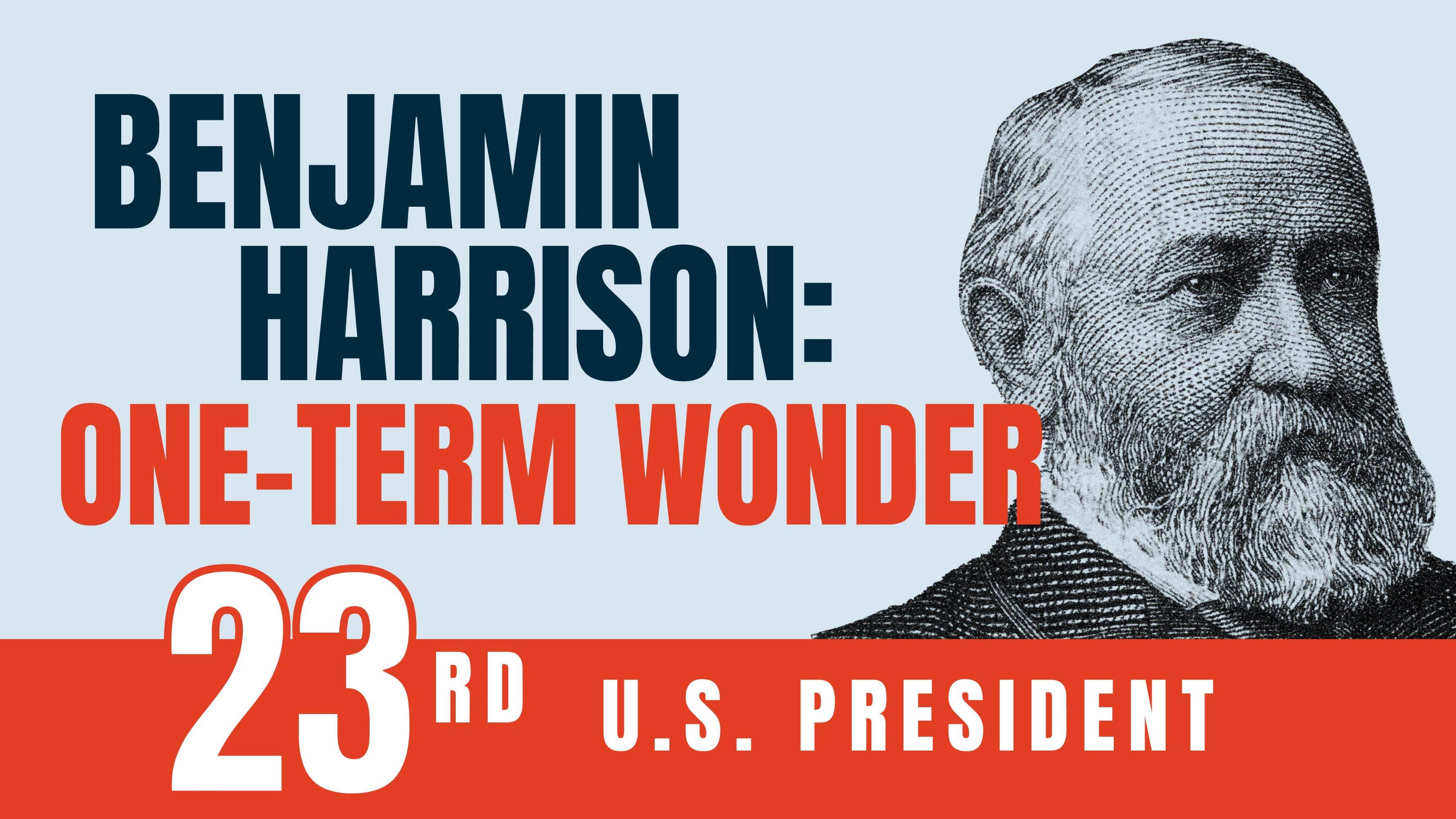
Benjamin Harrison: One Term Wonder
How could one president accomplish so much in such a short amount of time and not be reelected to a second term? Louis Picone, author of The President Is Dead!, explains the brief yet impactful presidency of Benjamin Harrison.
This video is part of the American Presidents 5-Minute Video Series.
Once you've seen them all, take our Presidents Quiz.
Topics
Hosted By
 Louis Picone
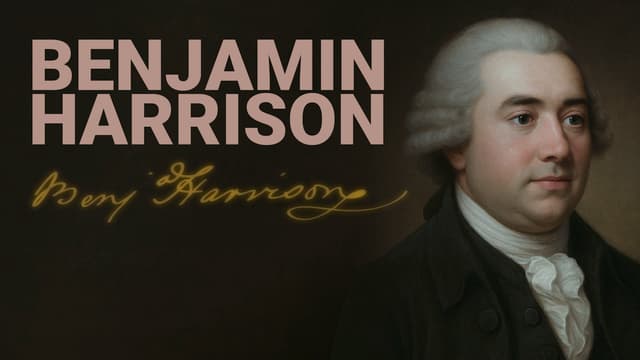
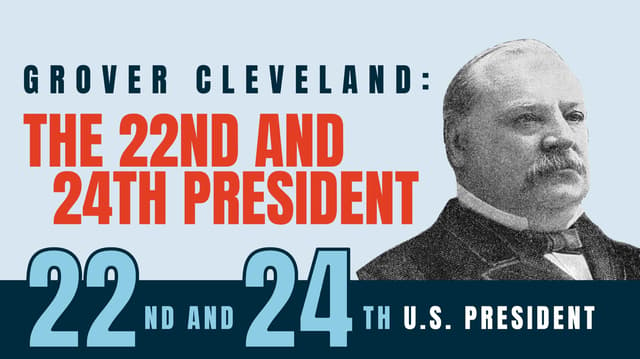
If anybody thinks of Benjamin Harrison–and very few people do–they think of him as the guy whose presidency is sandwiched between the two terms of Grover Cleveland.
But the twenty-third president of the United States is much more than the answer to a trivia question. One could make the case that Harrison was among the most consequential single-term presidents in American history.
Here’s just a partial list of what he accomplished in four years:
- Pushed through the first serious legislation to protect consumers: the Meat Inspection Act.
- Promoted merit over patronage as the basis of government employment, appointing a young, brash reformer named Theodore Roosevelt to the Civil Service Commission.
- Added six western states to the Union – a presidential record: North Dakota, South Dakota, Montana, Washington, Idaho, and Wyoming.
- Designated 22 million acres as forest reserves, establishing Sequoia and Yosemite National Parks.
- Signed the Sherman Antitrust Act, enabling the federal government to break up monopolies.
- Made America a legitimate naval power by adding over two dozen steel ships to the fleet. And…
- Established Ellis Island, bringing order to the nation’s immigration process.
There’s a reason why Frederick Douglass, the great civil rights leader, said of Harrison, “we never had a greater president.”
As much as any president in the second half of the 19th century, Harrison was repelled by the injustices inflicted on black Americans. He was committed to doing something about it.
“When and under what conditions is the black man to have a free ballot? When is he in fact to have those full civil rights which have so long been his in law?”
He answered the first question by endorsing legislation to protect blacks’ right to vote. That right had been enshrined in the 15th Amendment, but it was being subverted by the Democrat-dominated South.
Had he not been opposed by every Democrat and undermined by a few Republicans, the institutionalized racism of Jim Crow might have been a historical footnote rather than a terrible stain on America’s history.
Cynics might say, since blacks voted almost 100% Republican, Harrison had every reason to push such legislation. But Harrison was more than a politician, he was a deeply moral person. His views on the treatment of Black Americans were well-established before he entered the White House.
No one came to that residence with a better pedigree than Harrison. His great-grandfather Benjamin Harrison V signed the Declaration of Independence. His grandfather William Henry Harrison was the ninth president of the United States, and his father, John Scott Harrison, served in the House of Representatives.
Benjamin Harrison was born on August 20, 1833, in North Bend, Ohio. Although always aware of his impressive lineage, he never used it to his own advantage. As he told an audience early in his career, “I want it understood, that I am the grandson of nobody. I believe that every man should stand on his own merits.”
He attended Miami University in Ohio to be close to his future wife, Caroline Scott. After graduation, he and his new bride moved to Indianapolis, where Harrison practiced law.
With his strong anti-slavery leanings, he also joined the Republican Party almost as soon as it was formed.
Then in 1862, he left his now-prosperous legal career to enlist in the Union Army.
Like future presidents Hayes, Garfield, and McKinley, he served with distinction, rising from colonel to brigadier general. He saw heavy action under General Sherman in the Atlanta campaign.
After the war, Harrison returned to the law, becoming one of the leading attorneys in Indiana. In 1881, he was elected to the US Senate.
Once again, he distinguished himself as a model public servant—honest, hardworking, and in Harrison’s case, a gifted orator. These qualities earned him serious consideration in the race for the 1888 Republican nomination for president.
Harrison wasn’t anyone’s first choice, but he was everyone’s second choice. That proved good enough. He won the nomination in a field of seven candidates on the eighth ballot.
And then he beat sitting Democratic President, Grover Cleveland. Harrison won by combining something old with something new. The “old” was high tariffs to protect American businesses from foreign competition–a Republican staple since Lincoln.
The “new” was generous pensions to Civil War veterans – a popular policy Cleveland strongly opposed.
It was a very close election. Cleveland won more votes, but Harrison won the Electoral College, and thus, the presidency.
Workmanlike in everything he did, Harrison’s four years in office, as I’ve already described, were incredibly productive.
In 1892, Harrison was again opposed by Grover Cleveland. But this time, several factors worked against Harrison. The Civil War pensions busted the budget, consuming almost 40% of total spending, resulting in the first “Billion Dollar Congress.” The high tariffs that had helped Harrison win in 1888 by protecting industry in the East alienated farmers and ranchers in the West.
No less damaging but much more tragic, his wife Caroline was dying of tuberculosis. Harrison refused to leave her side and never campaigned on his own behalf.
Two weeks before the election, she died.
So stricken with grief was Harrison, he barely noticed he had lost.
I’m Louis Picone, author of The President Is Dead!, for Prager University.