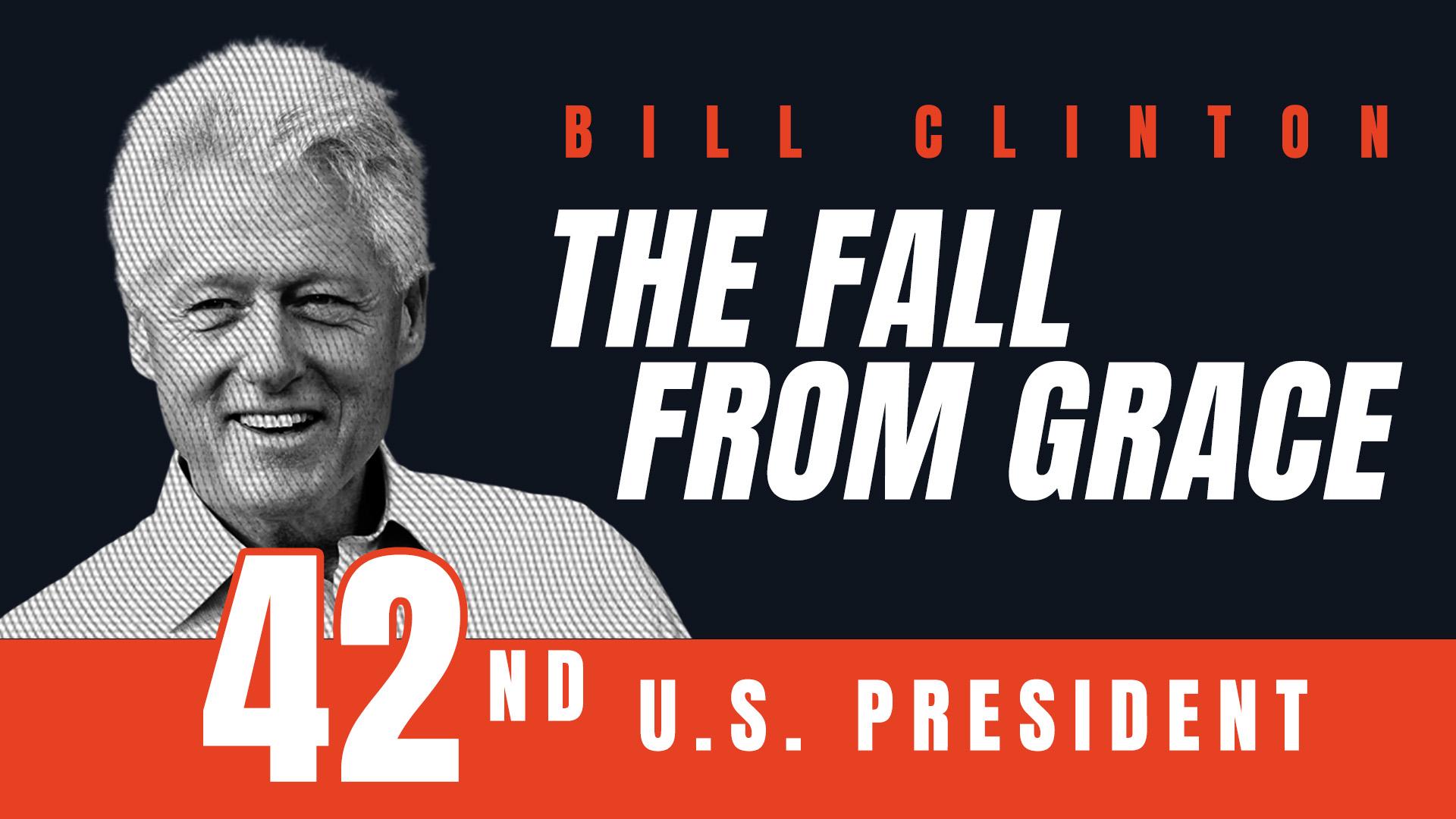
Bill Clinton: The Fall from Grace
Bill Clinton may have been the most fortunate president in U.S. history. He took office at a time of unparalleled peace and prosperity, when America stood alone as the world’s superpower. What did Clinton do with this unprecedented opportunity? Historian and political commentator Bill Whittle tells the story of a president who accomplished much, but could have accomplished so much more.
This video is part of the American Presidents 5-Minute Video Series.
Once you've seen them all, take our Presidents Quiz.
Topics
Hosted By
 Bill Whittle
When Bill Clinton took office on January 20, 1993, at age forty-six, he was the first of his generation—the baby boomers born after World War II—to reach the White House.
The United States had recently won its four-decade-long Cold War with the Soviet Union, making it the dominant nation in the world. Everything seemed possible.
“There is nothing wrong with America,” Clinton told the inauguration crowd, “that cannot be cured by what is right with America.”
But nothing went right in Clinton’s first few months on the job.
Intending to prove himself as a no-nonsense commander-in-chief, in the summer of 1993 Clinton ordered U.S. troops to capture a troublesome warlord, Mohamed Farrah Aidid, in Mogadishu, Somalia. Despite the American soldiers’ heroic efforts, it was a high-profile disaster. Eighteen Americans had died in the infamous ‘Black Hawk Down’ incident, and as a result, Clinton got cold feet. He immediately ordered the remaining troops out of the country. The new president looked like a hopeless amateur.
That perception only intensified when his proposal to take over the American healthcare industry, a full one-seventh of the economy, blew up in his face. Aiming to cement his place in history next to Democratic Presidential icons Woodrow Wilson, Franklin Roosevelt, and Lyndon Johnson—all of whom massively expanded the reach of government in Americans’ lives—Clinton sought to create a European-style universal healthcare system. He compounded his mistakes by putting his wife Hillary in charge of the project. Ultimately, the sheer size of the proposal (it was over 1,300 pages long and would cost hundreds of billions of dollars), and Hillary’s lack of transparency (she held all her policy meetings in secret) provoked fierce opposition, sinking the bill.
It also led to massive Democratic losses in the 1994 midterms. The Democrats lost eight Senate seats and a staggering fifty-two House seats, giving Republicans control of both chambers for the first time in forty-two years.
The center of gravity in Washington suddenly shifted to the Republican House Speaker Newt Gingrich, the mastermind of the GOP tidal wave. When Clinton tried to assert his authority, he only sounded more desperate, insisting, “I am relevant… A president… has relevance.”
No one was listening. It very much seemed like Bill Clinton would be a one-term president.
But then, in April 1995, domestic terrorists blew up the Alfred P. Murrah Federal Building in Oklahoma City, killing 168 people, including nineteen children. The nation went into shock and Clinton went into action. Suddenly he was everywhere, comforting both the residents of Oklahoma City and the American people. He was also steadfast in his conviction to capture and punish the perpetrators.
It was perhaps Bill Clinton’s Finest Hour. America had a president again. And the president had a renewed sense of confidence.
He also had a new strategy: he would co-opt his opponents’ best ideas. Guided by his savvy pollster Dick Morris, he worked with Republicans in 1996 to reform welfare programs, requiring beneficiaries to find work. He deregulated the telecommunications and financial industries, opening up the economy. He signed the Communications Decency Act, which allowed free speech to flourish in the world’s newest medium, the Internet. In short, he returned to his centrist, pragmatic roots. Before long, it was the Republicans grasping for relevance.
Clinton’s policies facilitated one of the longest peacetime economic expansions in American history, generated federal surpluses, and reduced the national debt. They also helped him sail easily to re-election in 1996, becoming the first Democratic president since Franklin Roosevelt to win a second term.
But just when it seemed like he had finally mastered the office, it all came crashing down… and he would have no one to blame but himself.
In January 1998, an obscure internet site called The Drudge Report revealed that Clinton had had an Oval Office affair with a 22-year-old intern, Monica Lewinsky.
First, Clinton denied the rumors, then made matters worse by trying to lie his way out of the scandal. When called to testify under oath, he insisted that he never had a sexual relationship with “that woman.”
Nobody believed him.
In December 1998, the House of Representatives impeached William Jefferson Clinton on a charge of perjury. It was the first presidential impeachment in 130 years.
Although the Senate Democrats ensured Clinton’s acquittal in February 1999, the Lewinsky affair preoccupied the nation for over a year. Worse, it distracted Clinton from focusing on a very real threat: the Islamic terrorist group Al Qaeda. In August 1998, the group attacked US embassies in Kenya and Tanzania, killing over 200 people. And then, in October 2000, Al Qaeda detonated a bomb next to USS Cole, a destroyer refueling at a port in Yemen, killing 17 American sailors. And he balked at his chance to take out the then-unknown leader of this newest threat to America: a young Saudi radical by the name of Osama Bin Laden.
And therein lies the real disappointment of the Clinton years. Although much was accomplished, so much more could have been done. Sadly, all most people remember about President Clinton is that he had a tawdry affair with a White House intern.
I’m Bill Whittle for Prager University.