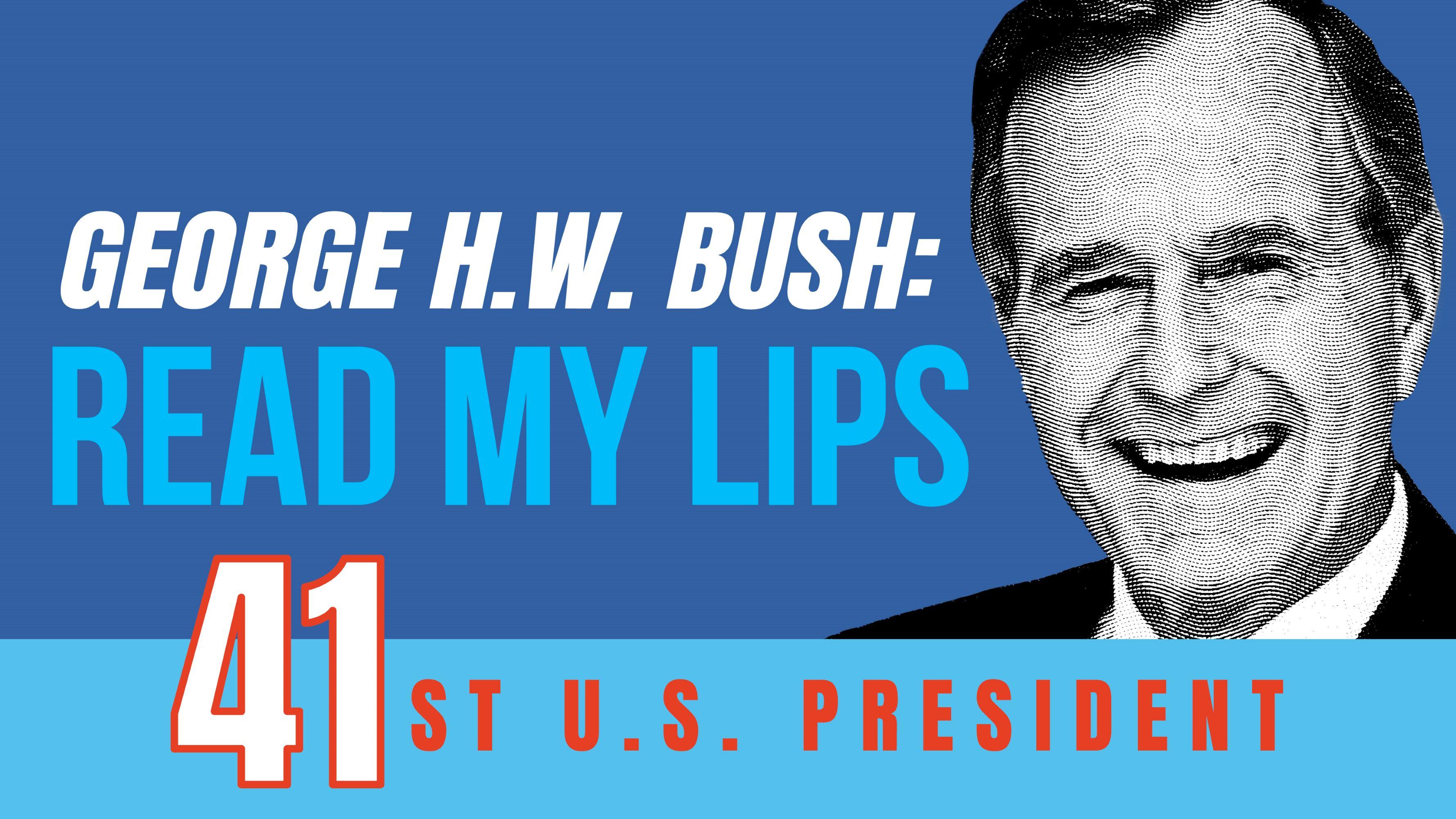
George H. W. Bush: Read My Lips
On the heels of a military victory in Iraq, a successful conclusion of the Cold War, and an 89% approval rating, President George H. W. Bush should have sailed effortlessly into a second term. But it didn’t work out that way. What happened? Presidential historian Tevi Troy explains.
This video is part of the American Presidents 5-Minute Video Series.
Once you've seen them all, take our Presidents Quiz.
Topics
Hosted By
 Tevi Troy
In 1991, George H.W. Bush, the forty-first president of the United States, had a record-breaking approval rating of 89%. Less than two years later, he lost his reelection.
To understand how it happened, we have to understand the man—both his strengths and his weaknesses.
George H.W. Bush was born on June 12, 1924 to a storied New England family. His ancestor, Dr. Samuel Prescott, rode with Paul Revere in 1775 to warn his fellow American patriots of the British invasion. Bush’s grandfather made a small fortune in the burgeoning steel business of the 1910s. His father, Prescott Bush, enlarged that fortune as a banker and later became a U.S. senator.
Young George could have had a cushy life, but he didn’t want it. After Pearl Harbor, he enlisted as soon as he could, becoming the youngest pilot in the U.S. Navy. He wasn’t yet 19 years old. He flew 58 missions. That he survived was a testament to his skill, fortitude, and some luck.
Following the war, and graduation from Yale (in two and a half years) he surprised everyone by moving his new wife Barbara and their young son, George W. Bush, to the middle of nowhere–Odessa, Texas. Rather than live off the family fortune, he decided to make his own fortune in the oil business.
It took a while, but he did it. In 1966, Bush sold his interest in the company he co-founded, Zapata Oil, to dedicate himself to a life in politics.
After losing a run for the Senate, he won a congressional election in suburban Houston. Recognizing a new political star, Republican leadership gave him a choice seat on the powerful Ways and Means Committee.
In Congress, Bush established a reputation as a political moderate, but one not afraid to take tough stances. For example, he was a strong supporter of civil rights legislation.
From Congress, Bush served in the Nixon and Ford administrations as U.N. ambassador, envoy to China, and director of the CIA, and then vice president for Ronald Reagan.
After that there was only one job left: president.
Despite having a reputation as a genuinely nice guy–he often sent handwritten notes to friend and foe alike–Bush was not afraid to throw sharp political elbows. In the 1988 presidential campaign, he painted his Democratic opponent, Massachusetts Governor Michael Dukakis, as a soft-on-crime liberal. The paint stuck. Bush won 40 states.
Almost immediately, he achieved success in foreign policy.
First was his triumph in the Persian Gulf.
Following an unprovoked invasion of Kuwait by Iraqi dictator Saddam Hussein, Bush organized a 34-country coalition to liberate Kuwait in Operation Desert Storm in January 1991. The coalition achieved an overwhelming military victory in less than two months. The swift win with few casualties also helped to end the “Vietnam Syndrome”–the idea that America no longer had the confidence to project its military power when provoked. In addition, respect for the armed services was restored.
Second, was Bush’s masterful handling of the end of the Cold War, the dissolution of the Soviet Union, and the reunification of East and West Germany–all without firing a single shot. We take this for granted now, as if it was something preordained, but it could have easily spiraled into chaos or worse. By keeping a cool head, Bush made it possible for the Soviet empire to peacefully fade away. He stayed in close contact with Soviet leader Mikhail Gorbachev, and then his successor Boris Yeltsin, to make sure that the Russian nuclear stockpile remained fully secured.
With these achievements, it’s not hard to explain why Bush, in March 1991, was polling as the most popular president ever to that time.
So, what went wrong?
As good as Bush was with foreign policy, that was how much he struggled on the domestic side. Among his worst mistakes was going back on his famous campaign promise, “Read my lips. No new taxes.” Given that he had to deal with Democratic majorities in both the House and the Senate, maintaining such a pledge would have been challenging, but breaking it severely damaged Bush’s credibility.
It also didn’t help that the nation fell into a recession. Suddenly, Bush was the silver-spoon guy who couldn’t relate to everyday Americans’ kitchen table concerns.
There was one domestic decision, however, that showed Bush at his finest: his nomination of Clarence Thomas for the Supreme Court. When Thomas was unfairly accused of sexual harassment during his confirmation hearing, there was a lot of political pressure on Bush to withdraw the nomination. But he never considered it. Bush gave Thomas his unwavering support, and Thomas was confirmed.
The election of 1992 came down to the economy. And here, despite the fact that recovery was well underway, Bush was unable to find his footing. He knew how to talk to foreign leaders, but he sometimes stumbled when talking to his fellow citizens.
Bush handled his election loss to Arkansas Governor Bill Clinton with his signature grace and class. But he got a measure of vindication eight years later when his son George W. succeeded Clinton as the 43rd president of the United States, making H.W. and G.W. the first presidential father-son pair since John and John Quincy Adams 172 years earlier.
I’m Tevi Troy, presidential historian, for Prager University.