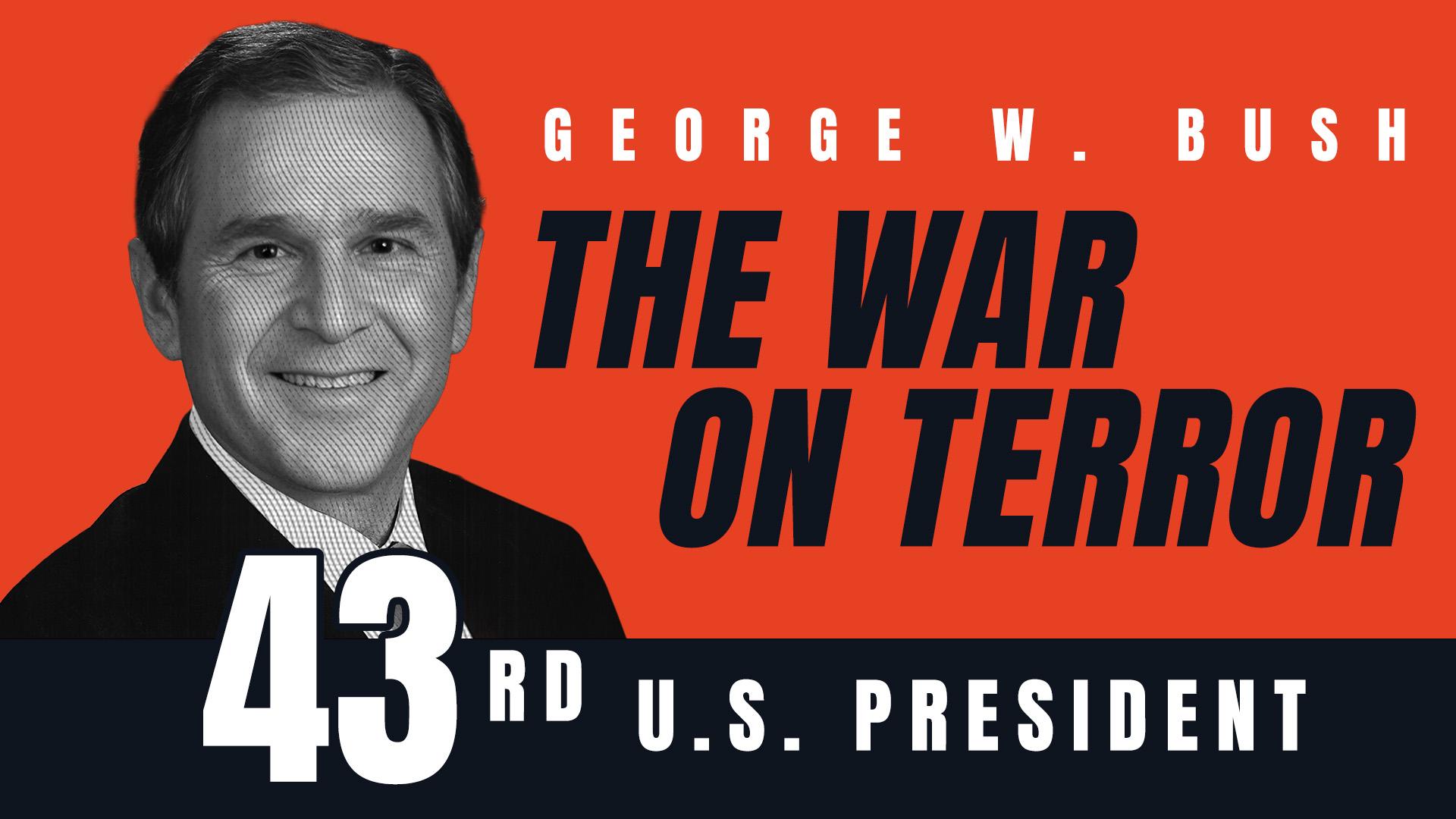
George W. Bush: The War on Terror
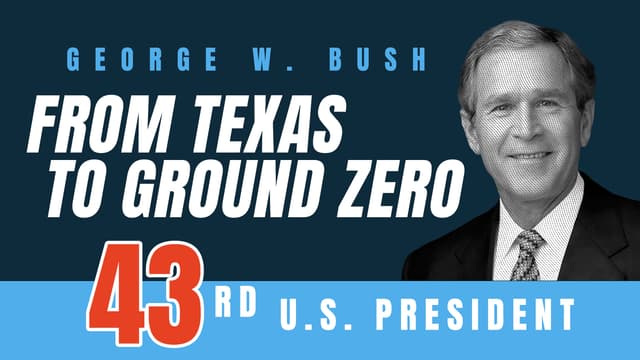
After radical Islamic terrorists struck the World Trade Center and the Pentagon on September 11, 2001, George W. Bush, the 43rd President of the United States, swung into action. His every thought was about keeping America safe. But 9/11 was only one of several major crises Bush would have to face. Elizabeth Spalding, senior fellow at Pepperdine University School of Public Policy, examines Bush’s challenging presidency.
This video is part of the American Presidents 5-Minute Video Series.
Once you've seen them all, take our Presidents Quiz.
Topics
Hosted By
 Elizabeth Spalding
After radical Islamic terrorists struck the World Trade Center and the Pentagon on September 11, 2001, George W. Bush, the new 43rd President of the United States, swung into action. His every thought was about keeping America safe.
Supported by a highly experienced team consisting of Vice President Dick Cheney, Secretary of State Colin Powell, Secretary of Defense Donald Rumsfeld, and National Security Advisor Condoleezza Rice, Bush—himself a former Texas Air National Guard fighter pilot--declared a War on Terror. The real-life villain was Osama Bin Laden, the leader of the Islamic terrorist group Al Qaeda and the mastermind of the 9/11 attack.
Bush emphasized that he would “make no distinction between the terrorists who committed these acts and those who harbor them.” This put Afghanistan’s Taliban regime, which had given Al Qaeda safe haven, in the crosshairs.
In October 2001, Bush ordered military action in Afghanistan. Within two months, the Taliban was overthrown, replaced by a new government friendly to the United States. Osama Bin Laden, however, evaded capture.
Bush could have ended it there. But he worried that a new attack, perhaps of even greater magnitude, was inevitable. The main source of his fear was Saddam Hussein, the dictator of Iraq, and long-time sponsor of terrorism. With a history of violating UN resolutions and fierce antagonism to the U.S., Hussein boasted about his nuclear weapons program. The CIA and Great Britain’s MI6 insisted it wasn’t a bluff.
The United States, Bush argued, couldn’t “wait for threats to fully materialize.” He declared that if Iraq did not abandon its “weapons of mass destruction,” America would act. When Hussein ignored him, Bush, with the support of both Republicans and Democrats, made good on his warning. In March 2003, U.S.-led forces invaded Iraq. Within one month, Hussein was gone, and within two months, Bush stood on the deck of an aircraft carrier in front of a banner that declared, “Mission Accomplished.”
Bush looked like a bold, decisive leader prepared to do whatever was necessary to protect the homeland. Voters rewarded him with a victory over the Democratic candidate, Massachusetts Senator John Kerry, in the 2004 presidential election.
As Bush’s second term began, however, the situation in Iraq deteriorated. The original plan to depose Hussein had morphed into a plan to remake the country into the first Arab democracy. The idea, the thinking went, was that if Iraq could become democratic, other Arab countries would follow. America hastily organized a Western-style election, but Iraqis’ tribal hatred for each other soon erupted. The U.S. was caught in the crossfire. American casualties mounted monthly, and the American public soured both on the war and on the president they had recently reelected.
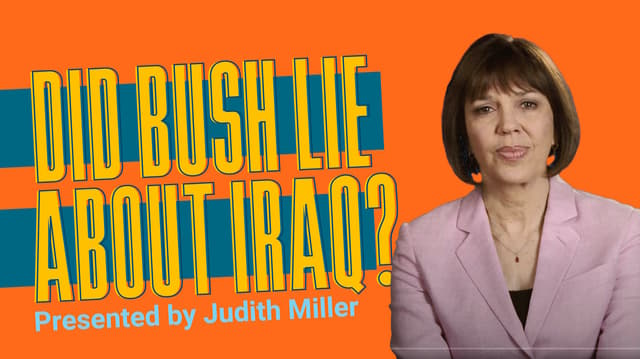
Bush’s problems were compounded when, after an extensive search, no weapons of mass destruction were found, undermining the rationale for the invasion.
Things went from bad to worse in August 2005. A massive hurricane, Katrina, devastated New Orleans, killing over a thousand people and destroying billions of dollars in property.
The media blamed Bush. A photo of the president looking down on the city from Air Force One, rather than being on the ground with those suffering, became the disaster’s defining image. That Bush couldn’t control the weather and was not responsible for the city’s inadequate infrastructure, was ignored.
When things seemed like they couldn’t get any worse, they did. In late 2007, the country was hit with a major financial crisis. Once again, Bush took the blame for something for which he was not responsible. For a decade, government policies—begun in the Clinton administration—encouraged banks to throw out the traditional lending standards by which they measured a homebuyer's creditworthiness. By the early 2000s, one could buy a home without making any down payment at all—something unheard of in previous generations. By the late 2000s, the bubble was ready to burst. When Bush refused to bail out Lehman Brothers, a legendary Wall Street banking firm enmeshed in home loans, it did.
Against his free-market instincts, Bush committed $700 billion to rescue the mortgage industry—an act some say saved the economy, but left Main Street angry that it was footing the bill for an irresponsible Wall Street.
Bush’s approval rating fell to a dismal 25%.
Yet, amid all these setbacks, Bush did something quite extraordinary, an act of true courage. When almost all his advisors, both military and political, told him to cut his losses, and accept defeat in Iraq, he refused. He believed that such an action would irreparably damage both America’s security and credibility with its allies. Rather than drawing down forces, he decided in January 2007 to increase them—a strategy that came to be known as “the surge.”
It worked. By the following year, American casualties had dramatically diminished.
When he handed the presidency over to his successor Barack Obama, there was a clear path forward for both Iraq and the U.S. economy.
It was an impossibly difficult two terms, but Bush could point to one undeniable fact—after 9/11, there had not been another such attack on American soil.
I’m Elizabeth Spalding, senior fellow at Pepperdine University School of Public Policy and Chairman of the Victims of Communism Memorial Foundation, for Prager University.