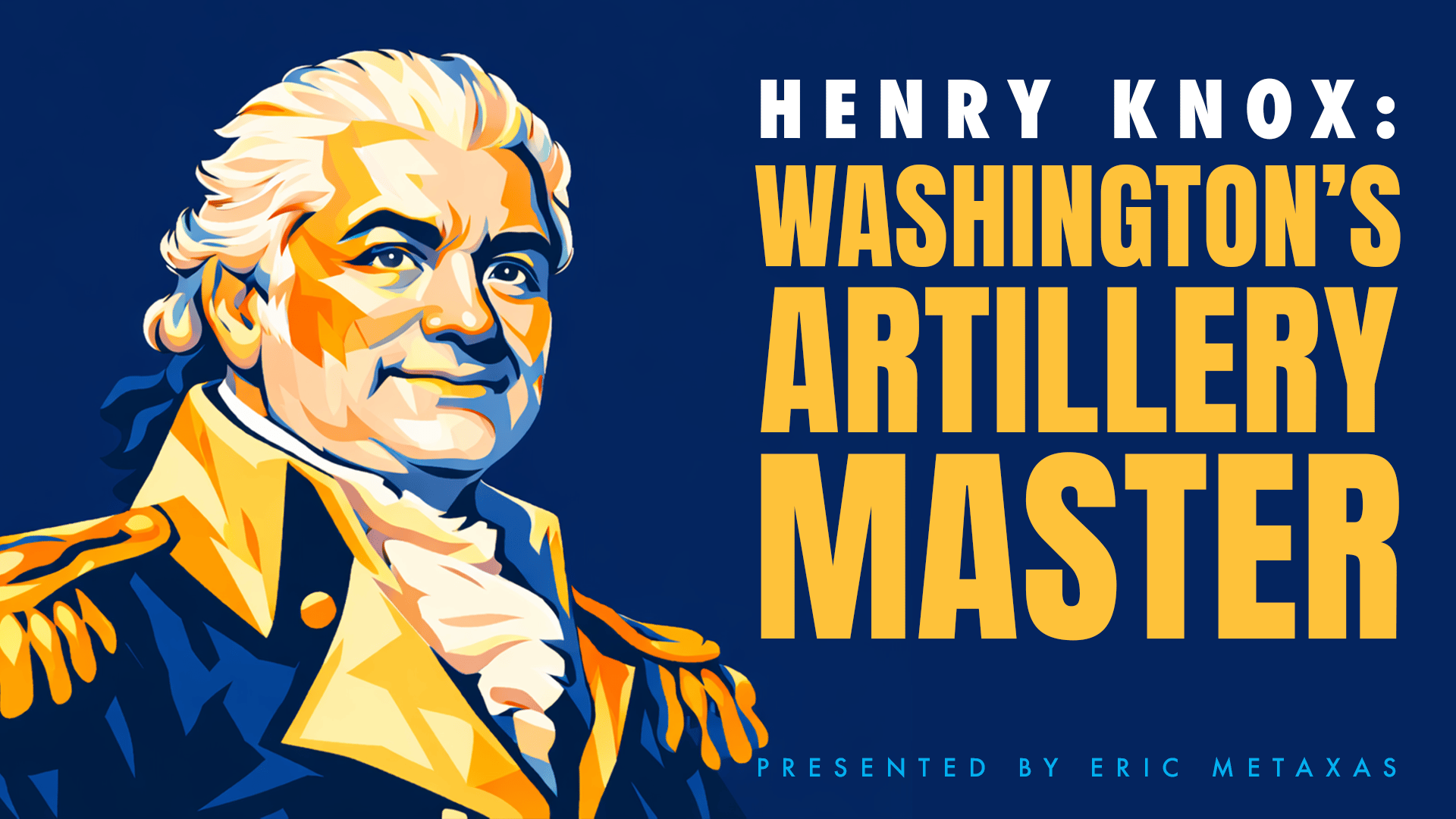
Henry Knox: Washington’s Artillery Master
The British held Boston. Washington needed cannons. Enter 25-year-old Henry Knox—a former bookseller who set out on an impossible winter mission to haul 60 tons of artillery 300 miles through snow, ice, and mountains. Eric Metaxas, author of Revolution, tells the remarkable story of the man who became George Washington’s chief of artillery.
Click here to watch more videos in the Unsung Heroes of the Revolution playlist.
Topics
Hosted By
 Eric Metaxas
The year was 1775 — winter. The Revolutionary War had begun. British General William Howe and his troops were encamped in Boston. In a few months, reinforcements would arrive. Then, he would finish off the “annoying” rebellion.
What American commander George Washington desperately needed was artillery. With cannon, Washington could bombard the city before those reinforcements arrived and force the British out. But Washington had almost none. The closest collection was 300 miles away in Fort Ticonderoga, New York.
Enter bookseller Henry Knox. He was all of twenty-five, big and burly with a booming laugh to match his size. He told Washington he could get him those Fort Ticonderoga cannons. It would take him a few weeks. Maybe a month. But he would get them and bring them back to Boston. Guaranteed.
Thus began one of the most remarkable stories of the American War of Independence and the military exploits of one of that war’s most important figures.
Knox’s first task was to break the news to his pregnant wife, Lucy. She had already sacrificed much. Her family were prominent Loyalists. They had disowned her for marrying Knox and for supporting the patriot cause. Now, with their first child on the way, Knox was asking her to make one more sacrifice. She wasn’t convinced by his assurances that his mission would be a quick trip to upstate New York and back. Still, she knew she couldn’t stop him.
The bookseller didn't know it yet, but the task he had taken on was, for all practical purposes, impossible. He had to haul the 59 artillery pieces from the fort, across lakes and rivers, and up and over the Berkshire Mountains.
When he and his men reached the fort, he found not a neat arsenal but a jumble of weapons: mortars, howitzers, and heavy bronze and iron cannon — some weighing more than 5,000 pounds — altogether, about sixty tons of artillery.
Now came the hard part: moving them 300 miles. Knox improvised. He had the guns loaded onto flat-bottomed boats to cross Lake George — only to be caught in a winter storm that nearly sank them.
Once ashore, the journey became even more brutal. To drag the cannon across the snow, Knox’s men built enormous wooden sleds and hitched them to teams of oxen. The sleds broke; the oxen faltered. More than once cannon crashed through frozen river ice and had to be hauled out by ropes and sheer manpower.
And then came the Berkshire mountains. The ascent was steep; the snowdrifts were as high as a man: temperatures often well below freezing. The climb was almost beyond human endurance. The descent was even harder; rope pulleys were wrapped around thick tree trunks to inch the sleds downhill.
Yet against every obstacle of weather, terrain, and exhaustion, Knox got the job done. In late January 1776 — two months after he started — he arrived outside Boston with his precious cargo, his “Noble Train of Artillery,” as he called it. Not a single cannon lost.
Washington could hardly believe it. His men erupted in cheers.
A few days later, in the dark of night, they hauled Knox’s cannon to the heights overlooking Boston. One morning in March, the British awoke to find American artillery aimed directly at them. Howe was in utter shock. He knew immediately that the city was lost. On March 17, 1776, the British evacuated Boston without a fight. It was the first major American victory of the war.
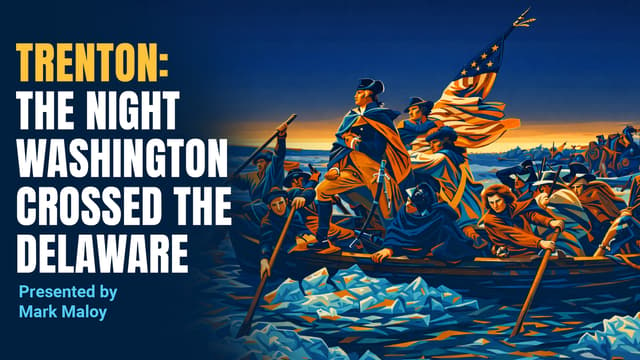
Knox could have gone home to Lucy and retired a hero. Instead, he stayed at Washington’s side. On Christmas Day 1776, he oversaw the famous crossing of the Delaware. As Washington’s chief of artillery, in battle after battle — Trenton, Princeton, Brandywine, Germantown, Monmouth — Knox’s guns provided the firepower that kept the Continental Army alive.
He did it by building an entire American artillery corps from scratch — setting up armories, developing supply lines, training gunners. His methods became the foundation for America’s first military academy, West Point.
At the war’s climax at Yorktown in 1781, Knox’s relentless bombardment of British positions helped force Lord Cornwallis to surrender. This effectively ended the Revolutionary War.
Washington never forgot who had delivered him his first real victory and who was with him through almost every hardship. He admired Knox not only as a soldier but valued him as a friend. When Washington became the first President of the United States, he chose Knox as the nation’s first Secretary of War.
Of all the men who served under him, none earned Washington’s trust more completely than Henry Knox.
He and Lucy had thirteen children, though tragically only three survived to adulthood. Yet, he never lost his good humor or his booming laugh. He died in 1806 at the age of 56, having lived a life of extraordinary service.
History often turns on the courage and ingenuity of individuals who overcome “the impossible.” The American Revolution could easily have ended in disaster in its first months. Instead, a twenty-five-year-old bookseller with no formal military training looked at a 300-mile snow-covered wilderness and said, “I’ll get it done.”
I’m Eric Metaxas, host of Socrates in the City and author of The Revolution, for Prager University.