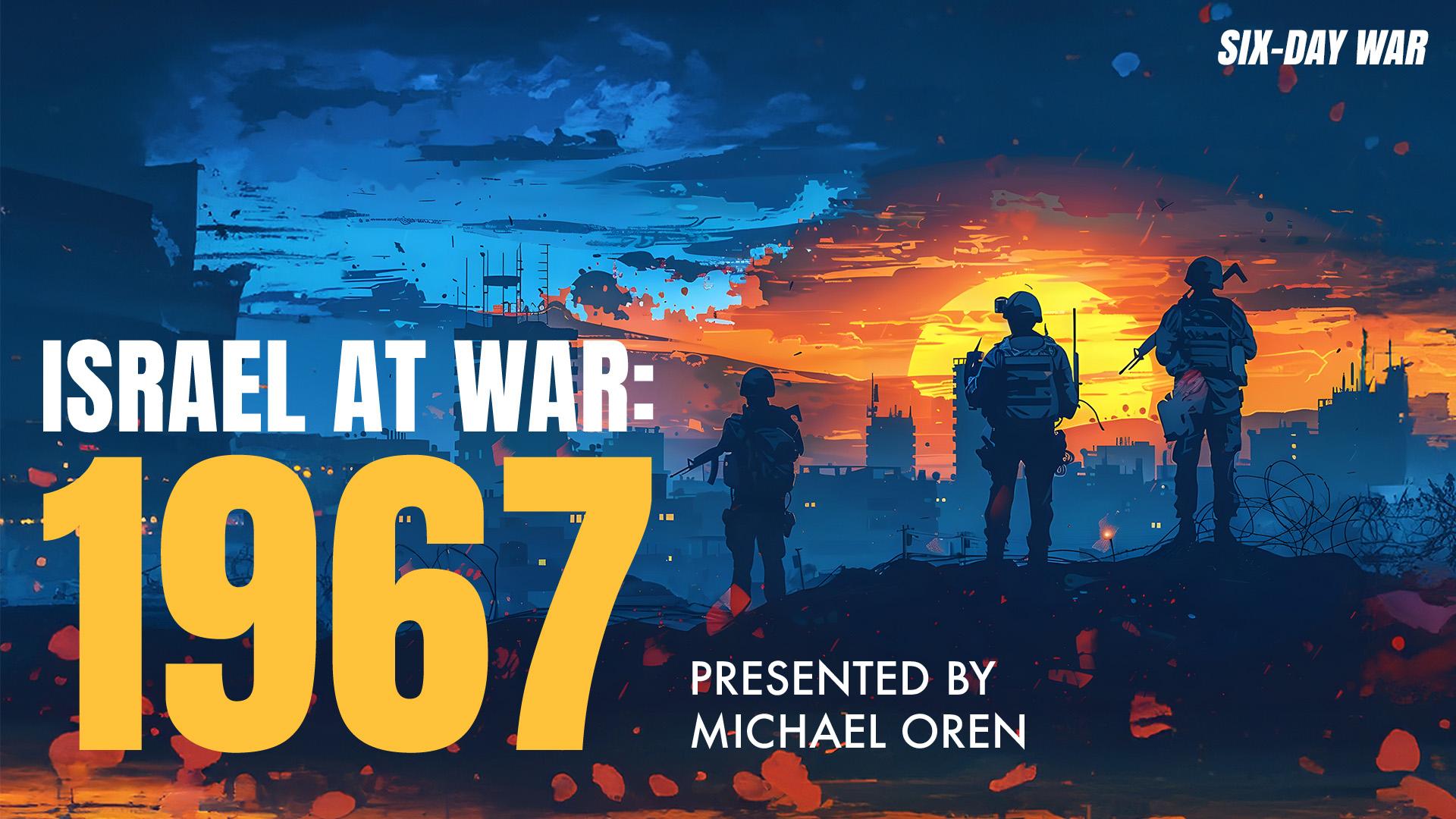
Israel at War: 1967
The state of Israel—less than 20 years old—was completely surrounded by the armies of Egypt, Jordan, Iraq, and Syria in June 1967. What was Israel to do: wait for the inevitable attack, or strike preemptively? Renowned historian Michael Oren shares the story of how Israel answered this question and stunned the world in the process.
Click here to watch every video in the Israel at War series.
Hosted By
 Michael Oren
Few events in modern history were as dramatic as the Six-Day War of June 1967, the war between Israel and four Arab nations: Egypt, Syria, Jordan, and Iraq.
Among other things, it changed the nature of the Middle East and the Israeli-Palestinian conflict, transferred control of the West Bank from Jordan to Israel, and unleashed Islamic extremism.
The origins of the war were complex.
They began with the rise of Pan-Arabism which sought to unite the countries — Syria, Iraq, and Jordan — created by the Europeans after World War I — into a single Arab state.
The question was, who would lead that state?
In their efforts to claim that role, Arab rulers tried to outdo one another in attacking Israel. Foremost among them was Gamal Abdel Nasser, the charismatic leader of the most powerful Arab country, Egypt.
To establish his leadership, on May 16, 1967, Nasser evicted the UN peacekeepers who served as a buffer between Israel and Egypt in the Sinai desert and the Gaza Strip, which was then under Egyptian control.
Nasser marched his army into the Sinai and threatened to “drive the Jews into the sea.”
He blockaded the Straits of Tiran, at the entrance to the Red Sea, choking off Israel’s vital southern port of Eilat.
He made a military alliance with Syria and Iraq.
He placed the Jordanian army under Egyptian command.
By the first week of June 1967, Israel was surrounded.
On its southern border, the army of Egypt.
On its eastern border, the armies of Jordan and Iraq.
On its northern border the army of Syria. suez
And on its Western border, the Mediterranean Sea.
And to make matters worse, Israel faced these threats virtually alone.
It had a tenuous relationship with Europe and friendly ties with the United States, but not a strategic alliance. The Israeli Defense Forces, the IDF, fought with French arms, not American arms. And, of course, the Soviets were antagonistic, having fully backed Nasser.
The situation was life-and-death. The normally fractious political parties of the Jewish state formed a national unity government with the dour Levi Eshkol as prime minister and the famed one-eyed general Moshe Dayan as defense minister.
The existential question of the moment for Israel’s politicians and generals was this: Should Israel wait for the inevitable attack and react? Or should it strike preemptively? And if it did, what if the attack should fail?
After much arguing and agonizing, Israel’s leadership chose to attack.
At 7:45 a.m. on the morning of June 5, Israel launched one of the largest air strikes in military history. The Egyptians were caught completely by surprise. In a matter of hours, Israeli planes wiped out three-quarters of Egypt’s air force, most of it on the ground. This gave Israel command of the skies, a major tactical advantage.
Then, Israeli ground forces rushed into the Sinai. Their goal was to neutralize the Egyptian threat and, by doing so, hopefully dissuade other Arab states from joining the fray. Israel repeatedly urged Jordan’s King Hussein to stay out of it.
It didn’t work. In a matter of hours, Israel was fighting a three-front war.
Jordanian forces fired thousands of artillery shells into West Jerusalem and the Tel Aviv area and attacked Israeli positions along the eastern border.
Syria, too, rained thousands of shells down onto Israeli towns and villages in the Galilee.
Israel responded as if the nation’s life depended on it.
It did.
In the open spaces of the Sinai desert, Israeli jets pulverized Egyptian forces from above while Israeli ground troops and tanks sent the Egyptians reeling back toward the Suez Canal.
Meanwhile, in the tight quarters of Jerusalem, Israeli paratroopers advanced into the eastern half of the city.
By the third day of the war, the Jordanian and Egyptian armies were in full retreat.
Israeli soldiers conquered all of Sinai up to the Suez Canal.
Responding to Palestinian attacks from Gaza, the IDF captured the Strip as well.
Most dramatically, on the morning of June 7, Israeli paratroopers realized a two-thousand-year-old Jewish dream of reuniting East and West Jerusalem and liberating the Old City.
“The Temple Mount is in our hands,” commander Motta Gur reported, as his troops danced in front of the Western Wall.
Only the Syrian front remained, with Syrian artillery still pounding Israel’s north.
Though fearful the Soviets would enter the war in defense of their ally, Moshe Dayan determined that the opportunity of securing the high ground of Israel’s northern border, the Golan Heights, could not be missed.
Advancing under furious Syrian fire, Israeli forces achieved their objective.
In six earth-shaking days, it was all over.
Israel had defeated multiple Arab armies, convincing American leaders to ally with the Jewish state and provide it with arms.
The world was stunned: a country of merely two and a half million people had defeated an Arab world of over one hundred million. A country eight miles wide at its narrowest point before the war had quadrupled the territory under its control.
But many challenges loomed, not the least of which was what to do with over a million Palestinians now under Israeli authority.
That question would preoccupy Israeli political, diplomatic and military thinking for many decades to come and still does to this day.
I’m Michael Oren, author of Six Days of War, for Prager University.