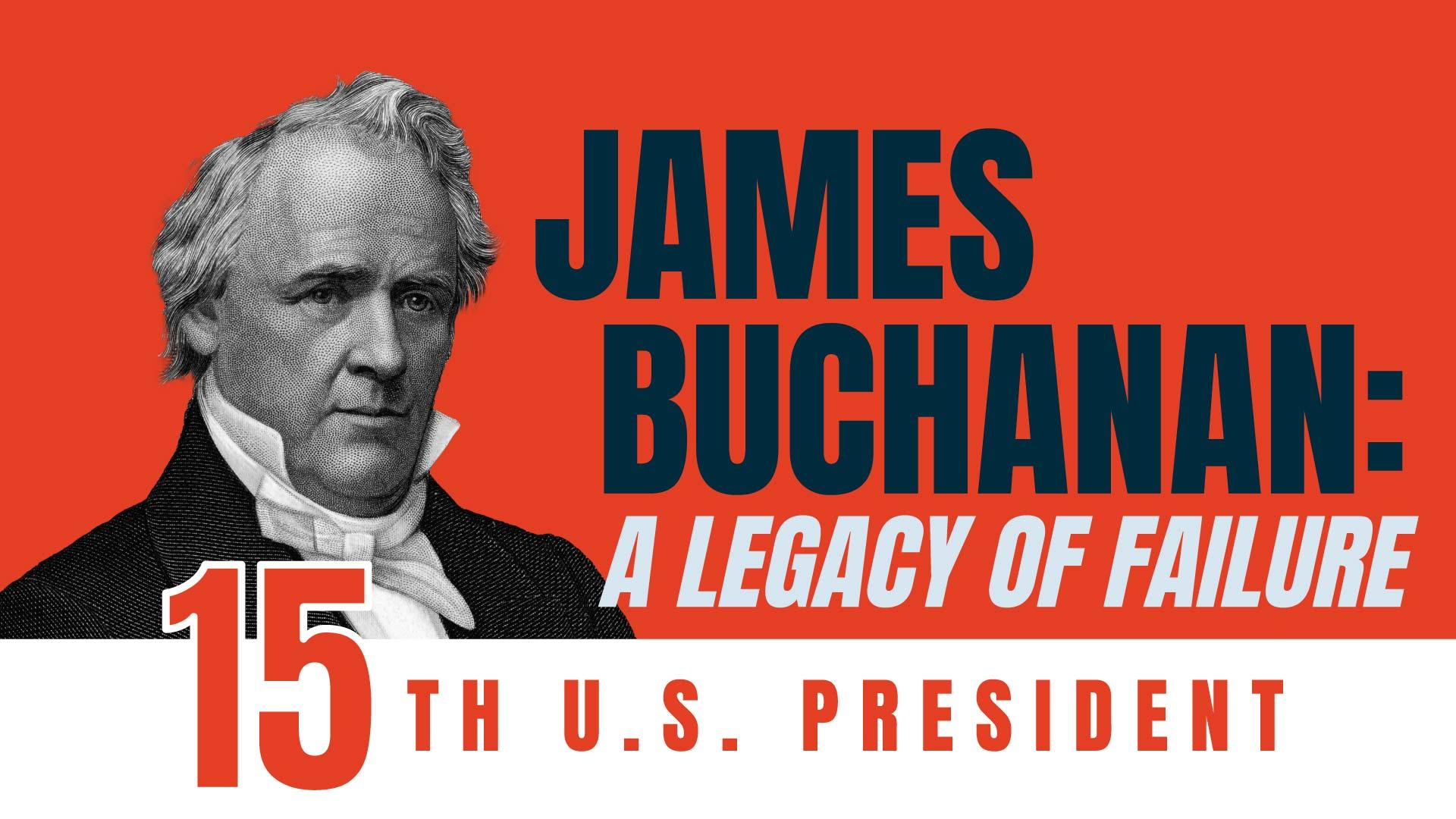
James Buchanan: A Legacy of Failure
When James Buchanan—America’s 15th president—took office, the country was ready to explode over the issue of slavery. Buchanan thought he could avert civil war. Instead, his every action (and inaction) made it inevitable.
This video is part of the American Presidents 5-Minute Video Series.
Once you've seen them all, take our Presidents Quiz.
Topics
Hosted By
 Joseph Fornieri
James Buchanan should have been prepared to be president. He had served as a congressman, a senator, a cabinet member, and an ambassador. He certainly wanted the job. He sought the office four times.
But when he finally achieved his ambition in 1856 and became the fifteenth president of the United States, his impressive resume did him little good. When he left office in 1861, the country was on the brink of civil war.
James Buchanan was born in a log cabin on April 23, 1791, in Cove Gap, Pennsylvania. His Irish-born father, James Senior, lived the classic early 19th-century immigrant story: he worked hard, lived frugally, and prospered. He and his American-born wife, Elizabeth, had great ambitions for their son, James Junior, and with the exception of a few stumbles—like getting kicked out of college for drunkenness—he didn’t disappoint them.
Pursuing a legal career, young James moved to Lancaster, Pennsylvania, where he took a strong interest in local affairs. Elected to Congress in 1820 as a Federalist, he switched his allegiance to the newly-formed Democratic Party in 1824, becoming a devoted follower of Andrew Jackson.
He supported states’ rights, a strict reading of the Constitution, and was sympathetic to Southern interests, including, of course, slavery. Northerners with such inclinations were known by their political opponents as “doughfaces,” men who were overly deferential to Southern grievances. Buchanan was more than happy to return the insult. He despised Northern abolitionists who, he believed, threatened the stability of the Union with their “extremist” views.
In 1844, he took his first run at the Democratic presidential nomination. He lost to former Tennessee governor James Polk. In 1848, he lost to Michigan Senator Lewis Cass. In 1852, he lost yet again, this time to New Hampshire’s Franklin Pierce. In 1856, the stars finally aligned. Buchanan won the Democratic nomination and then the presidency by defeating legendary explorer and abolitionist John Frémont of the newly-formed, anti-slavery Republican Party.
If Buchanan is known for anything, it’s that he was the only bachelor to become president. All the rumors you might have heard about his sexual orientation were common fodder even in his day. But there is no convincing evidence that the rumors were true.
When Buchanan took office, the country was a tinderbox, ready to explode over the issue of slavery.
Kansas, for example, had become a battleground between pro and anti-slavery forces. The two sides were literally fighting and dying over control of the state’s government.
Buchanan thought he had a way to extinguish the fire. His hopes rested on the outcome of a highly anticipated Supreme Court case, Dred Scott v. Sandford.
The dispute came down to this question: Did a former slave have standing to sue in federal court?
Buchanan actually knew the answer the Court would give before the decision was publicly announced. Indeed, he had secretly pressured the court to rule in the way he wanted: Slaves had no standing to sue in federal court.
That would’ve been bad enough, but Chief Justice Roger B. Taney, who wrote the majority opinion, went much further. He denied that blacks—even those already free—could ever be citizens of the United States. But it didn’t stop there: Taney also ruled that the federal government had no right to restrict the spread of slavery. To Abraham Lincoln and others, this meant that slavery would no longer be confined to a particular region of the country but would become a national institution.
Buchanan assumed, now that the Court had made its decision, the matter was closed.
But this was wishful thinking, in the extreme.
Instead of resolving the slavery issue, Dred Scott only inflamed it.
Then, in 1859, the match was lit. Radical abolitionist John Brown led an unsuccessful slave revolt in Harpers Ferry, Virginia. While many in the North hailed Brown as a hero and a martyr, the South regarded him as a dangerous terrorist. Southerners were now convinced that Northerners were plotting their destruction.
Meanwhile, Buchanan was caught in no man’s land. Both sides of his own Democratic party—the pro-unionist and pro-secessionist—saw him as weak and ineffectual. He did nothing to disprove that view. Although he declared secession unconstitutional, he likewise believed he had no authority to force the states to remain in the Union.
Exhausted, he had no trouble keeping his promise not to run for a second term.
Even so, the worst of his sins was yet to come.
Buchanan did almost nothing between November 1860 and March 1861, five impossibly long months before the newly elected Republican president, Abraham Lincoln, took office. The Southern states left the union one by one, seizing federal property as they went—forts, custom houses, post offices, and armories.
In short, Buchanan allowed the South to arm itself for war.
That war would come soon enough.
I’m Joseph Fornieri, professor of Political Science at the Rochester Institute of Technology and Director of The Center for Statesmanship, Law, and Liberty, for Prager University.