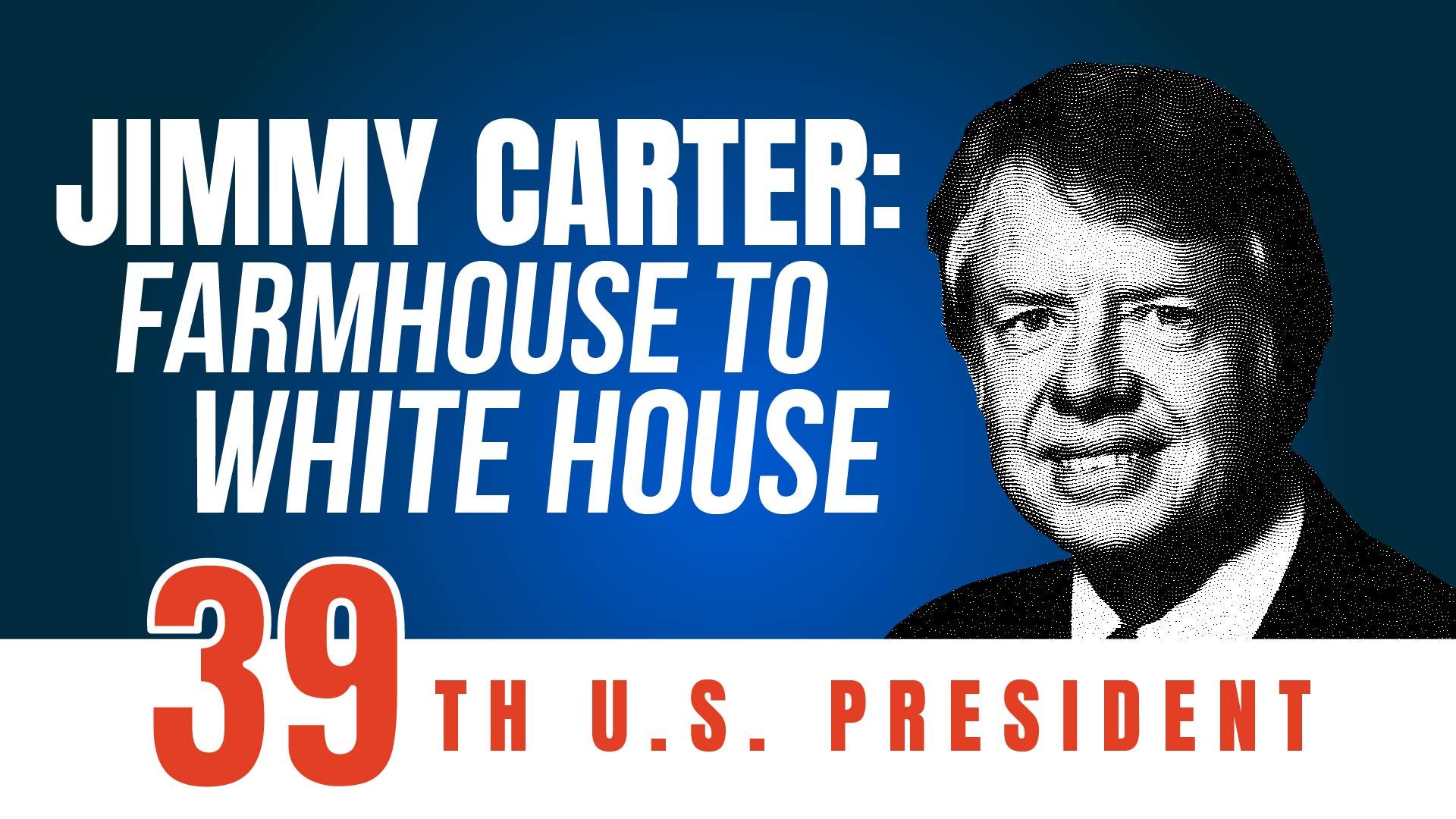
Jimmy Carter: Farmhouse to White House
After the Watergate scandal, Jimmy Carter had the perfect campaign slogan: “I’ll never lie to you.” No one questioned his character; only his policies. He thought he could change the world. But the world ended up changing him. Historian Tevi Troy tells the story of the 39th President’s rise and fall.
This video is part of the American Presidents 5-Minute Video Series.
Once you've seen them all, take our Presidents Quiz.
Topics
Hosted By
 Tevi Troy
In 1974, the Atlanta Journal Constitution headlined a story, “Jimmy Who is Running for What!?” The “who” was Jimmy Carter, the governor of Georgia, and the “what” was the presidency of the United States.
Carter could always count on people to underestimate him. This was one of the keys to his success.
He would outsmart, outwork, and outhustle his opponents. By the time they realized he was gaining political ground, he had already sped past them.
Jimmy Carter was born on October 1, 1924 to a prosperous farming family in Plains, Georgia. His father, Jimmy, Sr., was an unabashed racial segregationist, but his mother was of a different temper. She was well known in the town for inviting blacks into the Carter home. During her son’s presidency, she became famous in her own right as the ever-quotable “Miss Lillian.” When asked why someone wouldn’t vote for her son, she quipped, “Some people are just dumb.”
In 1943, Carter was admitted to the Naval Academy. Graduating near the top of his class, he decided to go into the submarine service. In 1952, he transferred into the recently formed nuclear sub program, mastering the technical aspects of nuclear engineering.
Then, in the middle of an already brilliant naval career, Carter stunned everyone when he gave it all up. After his father’s unexpected death in 1953, Carter abruptly returned to Georgia with his wife, Rosalynn, to manage the family peanut farm.
During these years, Carter was under a lot of pressure to join the town’s White Citizens’ Council. It certainly would have been good for business, but it would have violated his principles, and that’s something Carter would never do. He was a Southerner – no doubt about that – but he was always his own man.
As was his wont, as soon as Carter succeeded in one thing, he wanted to do something else. That something else was politics. He ran for the Georgia state legislature in 1962 and ran for Georgia governor in 1970.
Then, in 1976, he ran for president of the United States. He won all of those contests.
In the aftermath of the Watergate scandal that toppled President Richard Nixon, Carter had the perfect message: “I’ll never lie to you.” That message led him to victory against incumbent President Gerald Ford, making Carter the 39th president of the United States, and the first true outsider to occupy the White House since Abraham Lincoln.
As president, Carter brought his boundless energy to bear, not only on the nation’s problems, but the world’s. He wanted to solve everything all at once: peace in the Middle East, an end to antagonism with the Soviet Union, a foreign policy making human rights America’s first priority, and a new era of racial harmony at home.
But it was too much. Almost everything he tried blew up in his face. The man who had always been underestimated overestimated his ability to control events. There were two notable exceptions — one foreign and one domestic.
The foreign exception was the peace treaty he mediated between Israel and Egypt in 1978. Carter worked tirelessly to bring the two sides to a workable compromise. Given that the two nations had fought a war only five years before, it was a major achievement. The cold peace that resulted endures to the present day.
The domestic exception was the deregulation of the airline industry. Since the 1930s, the federal government set fares, routes, and schedules. Carter’s new policy liberated the airlines to figure this out for themselves. The result was an increase in competition and drastically lower airfares. A mode of transportation for businessmen became a mode of transportation for everyone.
These were rare triumphs in an otherwise troubled administration. Every week seemed to bring more bad news: stagflation (a recession and inflation happening at the same time), crippling energy shortages leading to long lines at gas stations, and a Soviet invasion of Afghanistan were just a few examples. These weren’t all Carter’s fault, but his tone-deaf reading of the national mood was a self-inflicted wound.
This was best illustrated in his controversial 1979 “Malaise speech” in which Carter called for gasoline rationing and chided the American people for being materialistic. Not surprisingly, it didn’t wear well. The country wanted inspiration and got a sermon instead.
The nail in Carter’s political coffin came later that year: the Iran Hostage Crisis. It began with Carter’s decision to admit the exiled Shah of Iran to the United States for cancer treatment. The shah, a long-standing American ally, had fled his throne ahead of Iran’s Islamic Revolution. Angered by Carter’s hospitality toward their former monarch, radical Muslim students took over the U.S. embassy and captured sixty-six Americans, fifty-two of whom were held hostage for a seemingly interminable 444 days. In April 1980, Carter authorized a military rescue operation, but it was poorly planned and poorly executed, ending in complete—and completely humiliating—failure. America had never seemed more impotent.
By November 1980, the nation was ready for a change. Ronald Reagan, with his natural ebullience and message of optimism swept Carter out of office, winning 44 out of 50 states, sending him into the longest ever post-presidency. It was a bitter pill for the successful naval engineer, peanut farmer, and Georgia politician to swallow.
At least he could say this, though: History would never again ask, “Jimmy Who?”
I’m Tevi Troy, presidential historian, for Prager University.