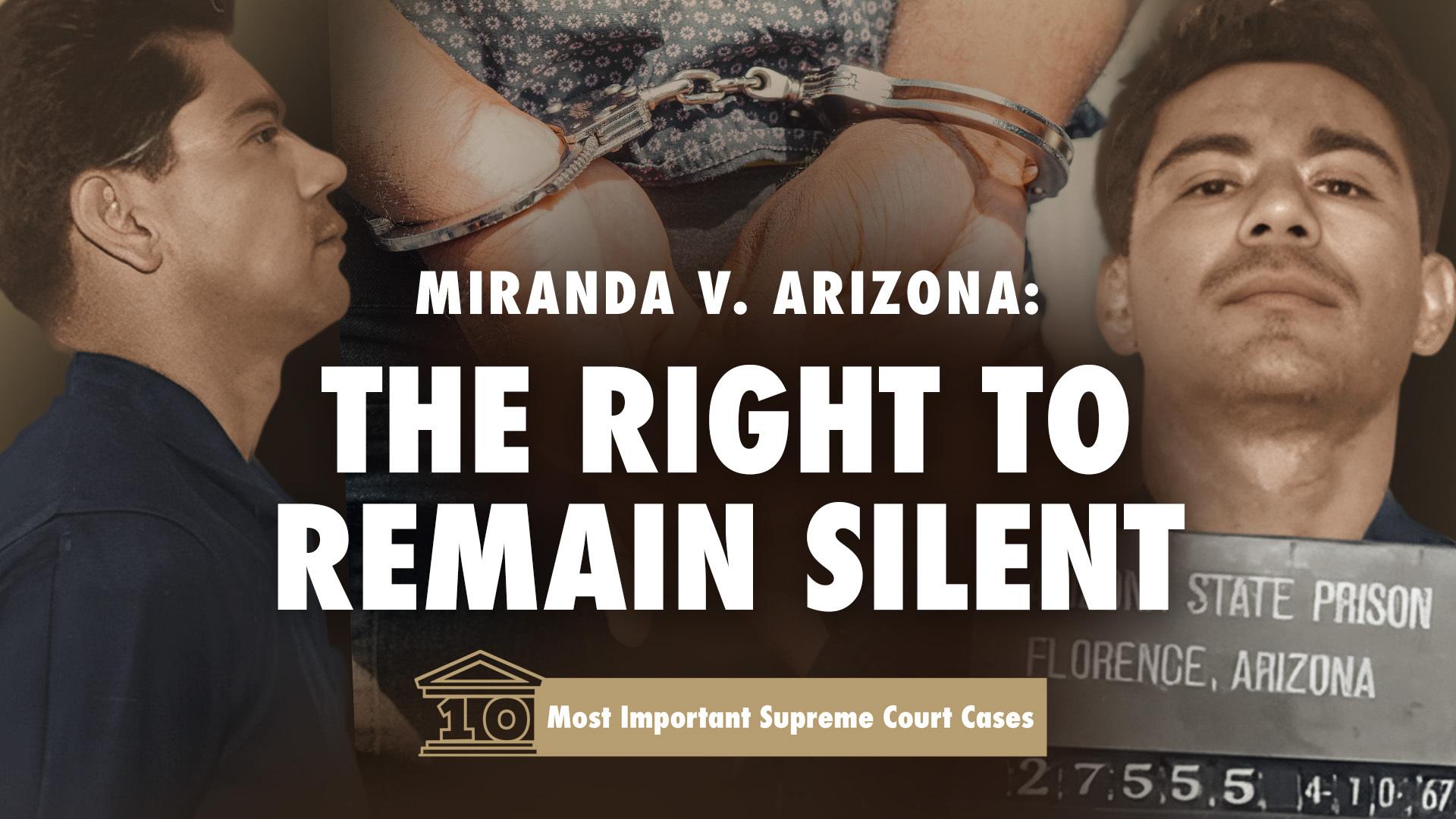
Miranda v. Arizona: The Right to Remain Silent
“You have the right to remain silent…” It’s one of the most famous phrases in American law. But where does it come from? In Miranda v. Arizona (1966), the Supreme Court ruled that police must inform suspects of their rights before questioning. John Malcolm of The Heritage Foundation explains how that decision reshaped criminal justice—and why it remains deeply controversial.
Hosted By
 John Malcolm
“You have the right to remain silent. Anything you say can and will be used against you in a court of law. You have the right to talk to a lawyer and to have him present with you during questioning. If you cannot afford to hire a lawyer, one will be provided for you.”
Anybody who has ever watched a TV cop show or a Dirty Harry movie, or read a police thriller, knows those words almost by heart. They are now part of American culture.
Where did they come from?
They were not the invention of a Hollywood screenwriter. They were the invention of five Supreme Court justices.
The words are a paraphrase of the Court’s ruling in the 1966 landmark Supreme Court case – Miranda v. Arizona.
The case involved the rights of a criminal suspect named Ernesto Miranda.
Miranda was arrested in 1963 on suspicion of kidnapping and raping an 18-year-old girl. Identified by the girl in a lineup, Miranda was questioned by the police and confessed to the crime. He then wrote out his confession in his own hand. At the top of each page were the printed words: “This statement has been made voluntarily and of my own free will...”
His confession was introduced at trial, and he was convicted.
Miranda later appealed his conviction to the Supreme Court, arguing that he had not been advised of his right to remain silent or to have an attorney present during questioning. Therefore, he contended, his confession was invalid.
In a 5-4 decision, the Court agreed. Chief Justice Earl Warren wrote the majority opinion.
In-custody interrogation, Warren asserted, was by its very nature intimidating. All the advantages were with the authorities. In great detail, he laid out the many ways in which the police took advantage of the accused, often manipulating them into making confessions. This, he held, was a violation of the Fifth Amendment’s right against self-incrimination, which provides, “No person shall be… compelled in any criminal case to be a witness against himself...”
“Without proper safeguards,” Warren wrote, “the process of in-custody interrogation… contains inherently compelling pressures which work to undermine the individual’s will to resist and to compel him to speak where he would not otherwise do so freely.”
This was not a new issue. In 1936, in Brown v. Mississippi, the Court held that coerced confessions were inadmissible under the Constitution’s Due Process Clause, which states, “nor shall any State deprive any person of life, liberty, or property, without due process of law…”
In other words, before Miranda, the police couldn’t do whatever they wanted to get a confession out of a suspect. They had to abide by what was called a “totality of the circumstances” test to ensure that the confession was voluntary and not the product of what used to be called “the third degree,” that is, abusive interrogation tactics.
But this wasn’t good enough for the majority. It was too vague and gave the police too much latitude. A bright line, they said, needed to be drawn. Thus, the Court ruled that any incriminating statements the suspect made could be deemed to have been compelled — unless they had been read their “Miranda rights".
Any statements made without this warning would not be admissible in a court of law.
None of this went over well with the four dissenting justices.
They expressed two main objections.
First, they weren’t convinced that the majority’s opinion stood on solid Constitutional ground. Justice John Marshall Harlan wrote: “The Court's opinion, in my view, reveals no adequate basis for extending the Fifth Amendment's privilege against self-incrimination to the police station.”
Second, they expressed deep concern about the real-world consequences, namely an increase in crime, a price that would be paid by law-abiding citizens.
Justice Byron White warned:
“In some unknown number of cases, the Court's rule will return a killer, a rapist or other criminal to the streets... The real concern is… the impact on those who rely on the public authority for protection…”
White’s words proved to be prescient.
Soon after Miranda, confessions by criminal suspects fell by nearly half in several major cities, as did crime clearance rates, that is, the percentage of crimes solved. Clearance rates have remained below pre-Miranda levels ever since.
According to an exhaustive 2017 study done by Utah Law School Professor Paul Cassell, “simple visual observation of the long-term trends suggests that Miranda substantially harmed police efforts to solve violent crimes.”
Given the close vote and the issues involved, it’s not hard to see why Miranda remains one of the Supreme Court’s most controversial decisions.
It raised this fundamental question:
Did the Court stretch the Constitution to protect the rights of those accused of crimes at the expense of public safety?
Well, we know what Dirty Harry thinks.
I’m John Malcolm, Vice President of the Institute for Constitutional Government at The Heritage Foundation, for Prager University.