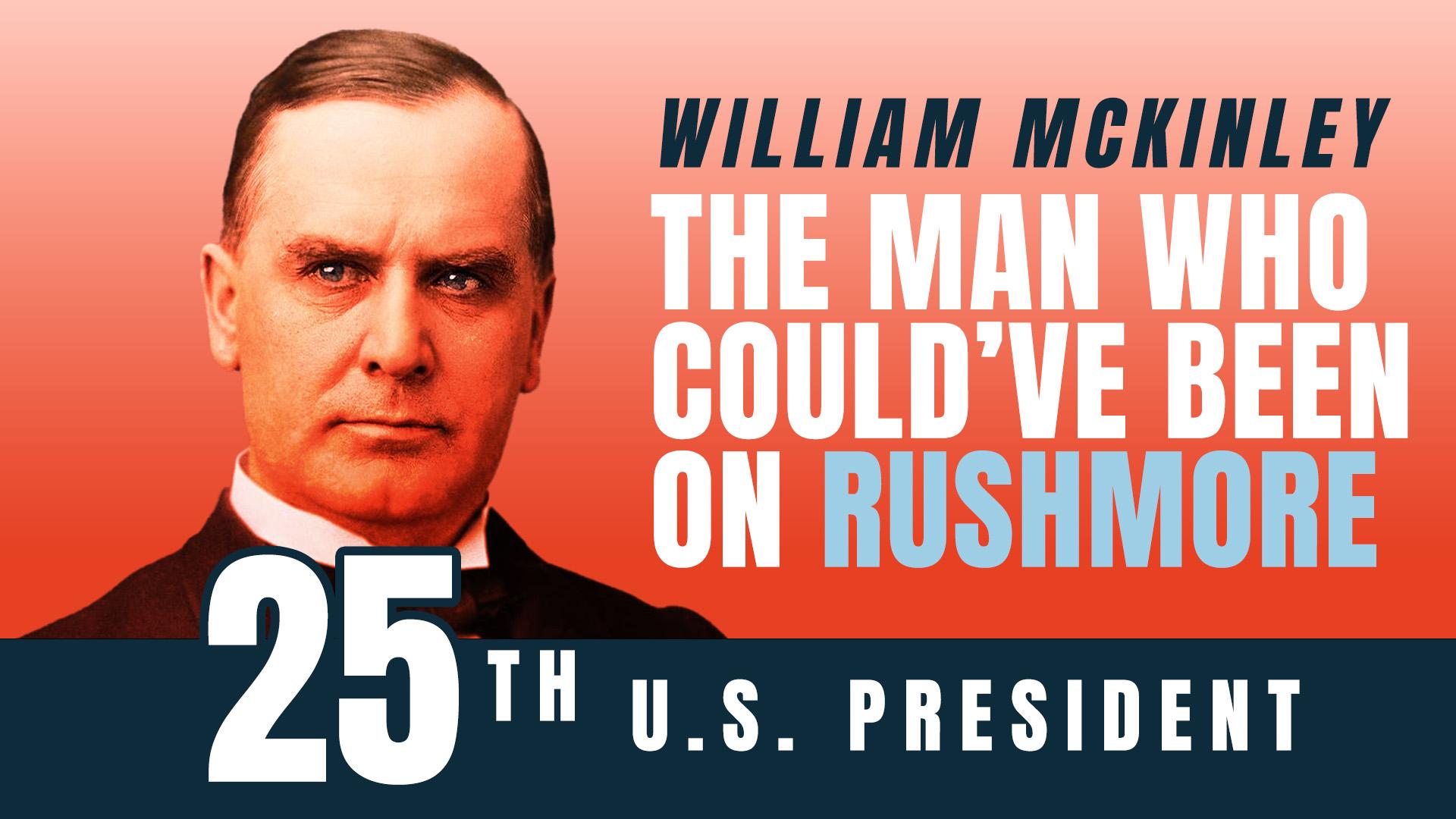
William McKinley: The Man Who Could’ve Been on Rushmore
As much as anyone, William McKinley laid the foundation for US dominance in the 20th century. Why, then, is America’s 25th president given such little credit for his accomplishments? Jason R. Edwards, professor of history at Grove City College, sets the record straight.
This video is part of the American Presidents 5-Minute Video Series.
Once you've seen them all, take our Presidents Quiz.
Topics
Hosted By
 Jason R. Edwards
There are four presidents on Mount Rushmore: Washington, Jefferson, Lincoln, and Teddy Roosevelt. Were it not for a crazed assassin, the face of William McKinley—and not TR— very well could have been carved on that mountain.
As it stands, the 25th president of the United States is almost an historical afterthought.
That’s a shame because, as much as anyone, McKinley laid the foundation for American dominance of the 20th century.
William McKinley was born on January 29, 1843, in Niles, Ohio. As far back as anyone could remember, he was sober, cautious, and responsible. He adored his deeply religious, abolitionist mother. She wanted him to become a minister, but when the Civil War broke out, 18-year-old William joined the Union Army as a private. He wrote his sister that he had decided “to serve my country in this, her perilous hour, from a sense of duty.”
He quickly came to the attention of his commanding officer, fellow Ohioan and future president, Rutherford B. Hayes, who made McKinley his chief quartermaster. As even-tempered as McKinley was, he was not afraid of taking great risks if he thought they were necessary. At the bloody Battle of Antietam, he drove a wagon full of food and water through heavy enemy fire to desperate Union soldiers.
“God bless the lad,” wrote Officer James Comley of McKinley’s heroic action.
Until the end of his life, McKinley preferred to be addressed by his final army rank—Major—saying, “I earned that. I am not so sure of the rest.”
At age 22, the veteran McKinley returned to Ohio, intent on a legal career. He quickly established himself as an extremely competent attorney.
In 1871, he married Ida Saxton, the daughter of a prominent local banker. They had two children, but both died tragically—one from typhoid fever at the age of three and one shortly after birth. These losses shattered Ida’s physical and emotional health. McKinley remained devoted to his wife, often spending hours a day with her, even during the busiest times of his political career.
McKinley was elected to Congress in 1876 and served there until 1891, ultimately becoming the chairman of the powerful Ways and Means Committee. His defining issue was the tariff. Like most Republicans of that era, he believed that American industry and workers needed protection from cheap foreign labor to thrive. The 1890 “McKinley Tariff” cemented his thinking into law.
It was on this issue that McKinley wanted to run as the 1896 Republican nominee for President. But the deciding issue turned out to be gold vs. silver—specifically, on which metal would the currency be based. McKinley was a “sound money man”—that is, he favored gold, the long-established foundation of the global economy. His Democratic opponent, William Jennings Bryan, favored silver. Crisscrossing the nation, Bryan famously proclaimed that, “You shall not crucify mankind upon a cross of gold!” McKinley, however, calmly remained on his front porch, winning the argument and the election.
Shortly after his presidency began, the gold issue faded, replaced by a brewing crisis ninety miles off the Florida coast: Cuban rebels were in full revolt against their Spanish overlords.
Reports of Spanish atrocities outraged the American people.
The popular press whipped this outrage into a frenzy. Demands for McKinley to intervene on the side of the Cuban freedom fighters were overwhelming.
But McKinley had seen war up close and knew its horrible reality.
Even when an explosion on February 15, 1898, destroyed the American battleship, the USS Maine, in Havana Harbor killing over 250 sailors—the press insisting it was an act of Spanish aggression—McKinley held back. By this point, he was convinced that war was probably inevitable but was worried that the Army and Navy were not fully prepared.
Finally satisfied that America was ready, on April 25 he signed a declaration of war.
The Spanish-American War lasted less than four months, ending in an overwhelming American victory. There were 385 American battlefield deaths, roughly 2,000 more dying from tropical disease.
The Spanish colonies of Cuba, Puerto Rico, Guam, and the Philippines came under American control. Hawaii, now more critical than ever as a naval station, was also annexed.
America had arrived as a global power, and everyone knew it.
That included most American voters. In 1900, McKinley easily won his re-election for a second term.
He came into his new term full of optimism. He had a strengthened majority in Congress and a vigorous, new vice president, the governor of New York, and hero of the recent war, Theodore Roosevelt.
McKinley had an ambitious agenda. Among his goals were securing the victories of the Spanish-American war, opening international markets for trade, particularly in China, augmenting civil rights for blacks, and finalizing negotiations to start building the Panama Canal.
And then fate intervened.
While attending the Pan-American Exposition in Buffalo, New York, on September 6, 1901, McKinley was shot by a self-proclaimed anarchist. He died eight days later.
Teddy Roosevelt took up McKinley’s mantle. In doing so, the charismatic new president permanently overshadowed his predecessor on his way to Mount Rushmore.
Fair or unfair, that’s how history frequently works.
I’m Jason Edwards, Professor of History and Humanities at Grove City College, for Prager University.