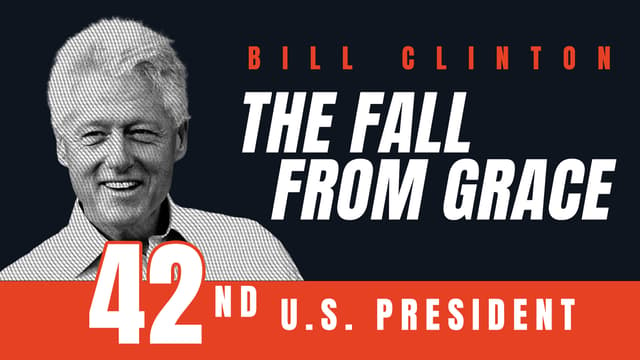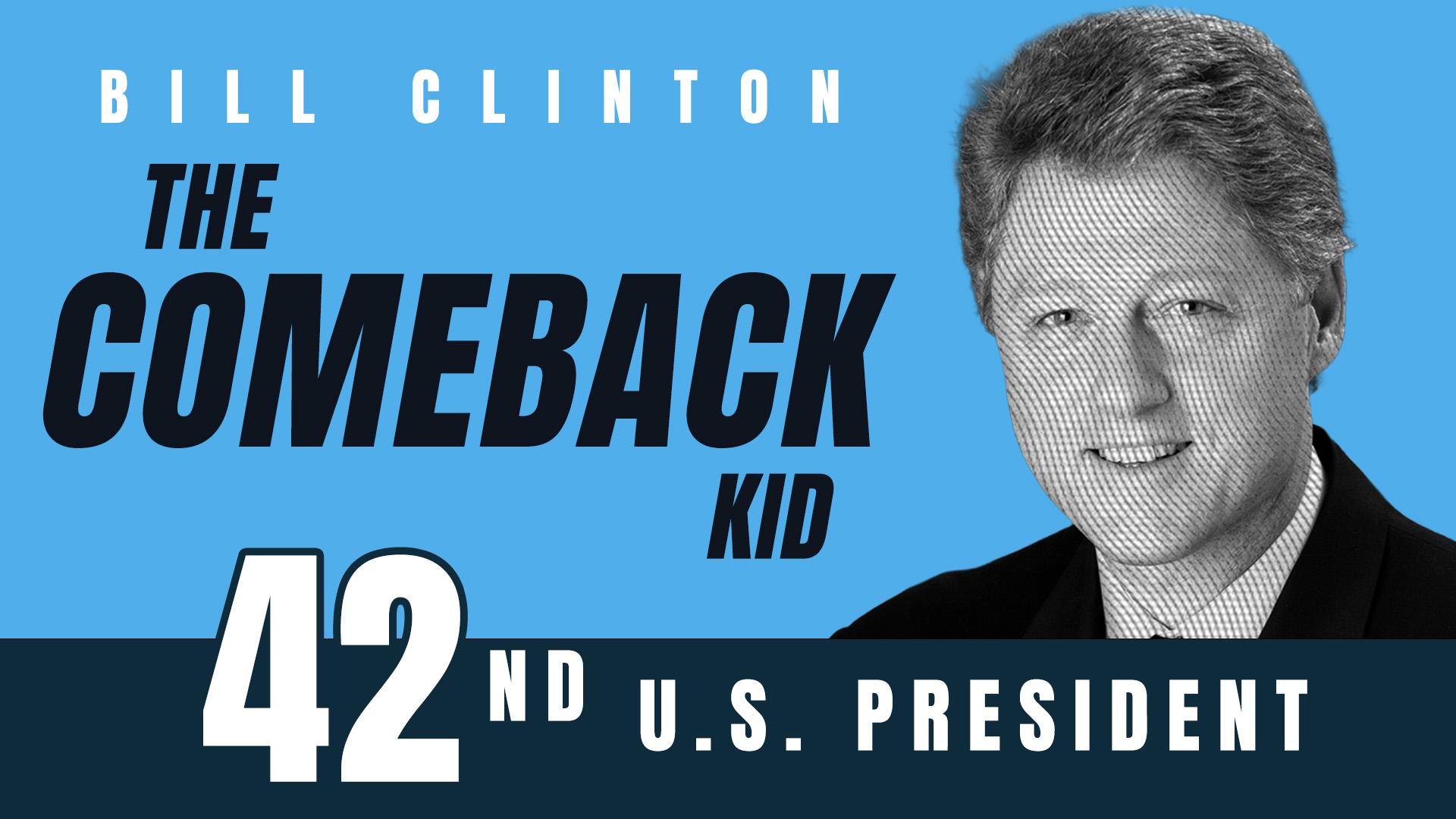
Bill Clinton: The Comeback Kid
At the start of 1992 nobody imagined Bill Clinton, an obscure Southern Governor, would become President of the United States. But by the end of the year, it seemed inevitable. How did this most skillful of politicians pull it off? Historian and political commentator Bill Whittle describes Clinton’s improbable triumph.
This video is part of the American Presidents 5-Minute Video Series.
Once you've seen them all, take our Presidents Quiz.
Topics
Hosted By
 Bill Whittle
Bill Clinton may have been the luckiest president in US History.
The forty-second president of the United States entered the White House just as the Cold War ended and left it just before the War on Terror began.
It was a time of unparalleled peace and prosperity, when America stood alone as the world’s superpower. The Soviet Union had crashed and burned, and China was only just beginning to make its presence felt.
Given this opportunity, what would Clinton do with it?
William Jefferson Clinton was born on August 19, 1946, in Hope, Arkansas. There was nothing privileged about his background. Whatever he made of his life, for good or for ill, he did on his own. His father, a traveling salesman who had been married five times before the age of 27, died months before Bill was born. His mother soon remarried, but her second husband, an abusive alcoholic, wasn’t exactly an upgrade from the first.
Yet somehow, young Bill managed to navigate his way through the wreckage. Blessed with a sharp mind and a winning personality, he developed a passion for politics early on, and found out he was good at it. He exuded likability.
In high school, he joined Boys Nation, a program where students learn how government operates. In 1963, the program allowed 16-year-old Bill to travel to the White House to meet America’s charismatic young president, John F. Kennedy. On the bus ride home, the awestruck teenager vowed to a friend, “Someday, I’m going to have that job.”
In 1964, he enrolled at Georgetown University. He majored in international affairs with an eye toward being a career diplomat. Four years later, he won a prestigious Rhodes Scholarship, allowing him to study at the University of Oxford in England.
By now, Clinton’s trademark charm was readily apparent. At Yale Law School, he applied that charm on one of his fellow students, Hillary Rodham, a serious and ambitious young woman from Chicago. Clinton pursued her for four years before she finally agreed to marry him in 1975.
Like his hero JFK, Clinton wasted no time seeking public office. In 1974, at just 28, he ran as a Democrat for one of Arkansas’ four congressional seats. Although he lost, he made a big impression. In 1978, he tried again — this time for the governorship. It was an audacious move but he pulled it off, becoming one of the youngest governors in American history.
Nicknamed the “Boy Governor,” Clinton made rookie mistakes, like raising an unpopular car registration tax. He lost his bid for re-election in 1980. He was now the youngest former governor in American history.
But Clinton was undeterred. Learning from his mistakes, he traveled up and down the state, working his charm on disaffected voters. And in 1982, he returned to the governor’s mansion.
He would be re-elected three more times.
Clinton governed as a centrist. He promoted liberal policies, such as affirmative action, but also conservative ones, such as raising the state’s education standards, encouraging people to get off welfare, and supporting the death penalty.
At the dawn of the 1990s, Clinton’s pragmatism began to attract the attention of Democrats outside of the South. Could Clinton be the savior they were looking for — a moderate who could lift the party out of its left-wing rut? The Democrats hadn’t won a presidential election since 1976. Clinton, never short of self-confidence, thought he was the man for the job.
In 1991, he declared his intention to challenge Republican President George H.W. Bush. That year, Bush’s approval rating had reached a sky-high 89%, thanks to his masterful handling of the Gulf War. Beating Bush seemed like a near-impossible task.
But first, of course, he would have to win the Democratic nomination.
Just as primary season began in earnest, his campaign hit a brick wall: an accusation of infidelity made by an Arkansas state employee named Gennifer Flowers.
On the popular TV news show 60 Minutes, Clinton denied the affair but vaguely admitted to “causing pain” in his marriage.
Despite the deflection, the TV appearance convinced voters to give him another chance, earning him the nickname “The Comeback Kid.” The Arkansas governor walked away with the nomination.
In the 1992 general election, he zeroed in on an economy that had fallen into a recession. His campaign manager, James Carville, kept the always-loquacious candidate on message: “It’s the economy, stupid.” Clinton made the sale, declaring to voters, “I feel your pain.”
Perhaps most importantly, Clinton benefited from the third-party candidacy of Texas billionaire Ross Perot. Running on a platform stressing the national debt and the outsourcing of jobs to Mexico, Perot’s campaign attracted many voters who otherwise would have voted for the Republican incumbent.
Split three ways, Clinton only won 43% of the vote, but it was enough to win an electoral college landslide, 370 to Bush’s 168.
Clinton had achieved his dream—he had John F. Kennedy’s job. But he had no idea how hard that job would be.
I’m Bill Whittle for Prager University.