Get credit for watching this video. Start your streak.
Trenton: The Night Washington Crossed the Delaware
Apr 27, 2026
·In the winter of 1776, it looked like the battle for independence was doomed. The British army had chased Washington out of New York. To salvage victory from defeat, the American general had one last play to make. He would attack his enemy on Christmas night. The password was “victory or death.” Historian Mark Maloy tells the desperate and inspiring tale.
Topics
Hosted By
 Mark Maloy
In spring 1776, the British sent a massive armada of 400 ships, carrying 32,000 men across the Atlantic. Led by General William Howe, a seasoned veteran of the French and Indian War, it was one of the largest invasion forces in the history of the world up until that time.
Its purpose was straightforward: quash the American rebellion once and for all.
It almost did.
That August, Howe thoroughly trounced George Washington and his fledgling Continental Army, driving them entirely out of New York City.
It was a humiliating defeat.
When it was over, Washington’s army of 20,000 was reduced to 5,000 from death, disease, and desertion.
“The game,” as Washington admitted to his brother in a letter, was “pretty near up.”
What to do now? Whatever it was, it would have to be something bold, something that would reignite the patriot cause, prove once again that the Americans could stand up to the British.
Was such an option even available?
Washington thought so. He had identified a chink in the British armor: an isolated garrison of 1,400 Hessian soldiers — German mercenaries hired by the British — encamped at Trenton, New Jersey.
Here was Washington’s plan: cross the Delaware River on Christmas night and surprise the Hessians in their beds, presumably where they’d be recovering from a night of revelry. Washington would attack from the north, supported by two smaller forces, led by General James Ewing and Colonel John Cadwalader coming from the south to seal off any escape.
The password for the attack perfectly encapsulated the stakes: “Victory or Death.”
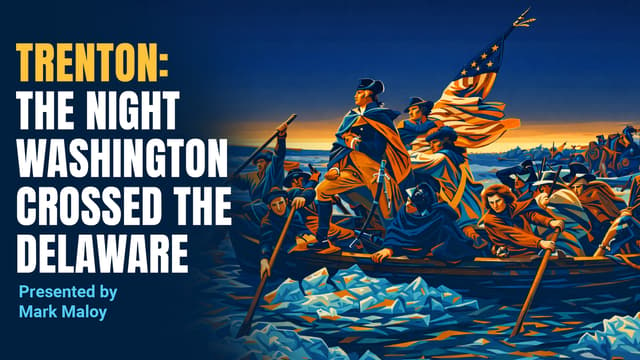
As the world sang yuletide carols, Washington led his 2,400 men and artillery across an ice-choked Delaware River. This is the scene immortalized in perhaps the most famous painting in American history by Emanuel Leutze.
What the picture can’t capture is how brutal that night was: fierce winds, stinging sleet, and endless snow.
The last troops and artillery made the crossing by 3 a.m. And then it was a nine-mile march to Trenton.
The storm put the army hours behind schedule and prevented Cadwalader and Ewing from crossing. Washington’s force would have to strike alone and after sunrise, when surprise would be lost.
Washington had to make a decision, one of those decisions on which the fate of nations rests: retreat or advance.
He didn’t hesitate — he advanced into the storm. That storm, so severe that two of his men froze to death, ended up saving his army. It cloaked their approach into the town, preserving the element of surprise.
The Hessians were caught off guard. They bravely attempted to mount a defense, but the Americans overwhelmed them.
It was all over in less than an hour. 22 Hessians dead, over 800 captured.
The Americans didn’t lose a single man in the battle.
It was a complete victory, beyond anything even Washington had imagined. But he and his men had no time to celebrate. Upon hearing of the Hessians’ costly surrender, a furious General Howe ordered General Charles Cornwallis and his force of 8,000 to run Washington down.
Cornwallis arrived in Trenton on January 2. Having his Christmas holiday interrupted put him in a foul mood. But the prospect of “bagging the fox,” as he put it, would more than make up for the inconvenience.
Washington, however, wasn’t done. Rather than defending Trenton, he decided to stay on the offensive. He didn’t want anyone to think that the first victory was a fluke.
His new target was Princeton. But first, he’d have to pull off another surprise. In the middle of the night, he and his troops snuck out of Trenton. To muffle the sound of their escape, they covered their wagon wheels with cloth. Washington also left a small contingent behind. Their job was to light campfires and make sounds with their picks and shovels to deceive the British into believing they were preparing for a morning battle.
But when morning dawned on January 3, the Americans were gone.
So far, so good. And then, when an advance force of rebels encountered a British patrol near Princeton, the ruse was undone. The British quickly rallied their forces. The American lines broke. And would have disintegrated had Washington not galloped between the two armies, placing himself at great peril.
“...My brave fellows,” he exhorted, “there is but a handful of the enemy, and we will have them directly!”
Inspired by their leader’s courage, the Americans advanced. When the battle ended, there were 80 American casualties, 500 British.
Washington had another victory. And this time, they hadn’t just defeated mercenaries; they had defeated British army regulars.
Just as Washington had hoped, these victories electrified the young nation. Thousands soon enlisted in the Continental Army, swelling its ranks.
The war was far from over. Ultimate victory would not come until years later, at Yorktown in 1781. But it wouldn’t have been possible without the guts and guile displayed by Washington and his men at Trenton and Princeton.
I’m Mark Maloy, author of Victory or Death: The Battle of Trenton and Princeton, for Prager University.